Hurricane & Impact-Rated Doors · Southwest Florida
Storm-ready garage doors, built for the Gulf Coast.
Your garage door is the largest opening in your home — and the one most likely to fail in a hurricane. Here's how wind-load and impact ratings protect your house, lower your insurance, and stand up to salt air.
Wind-zone spec'd · Permit & wind-mit docs handled · Since 1991
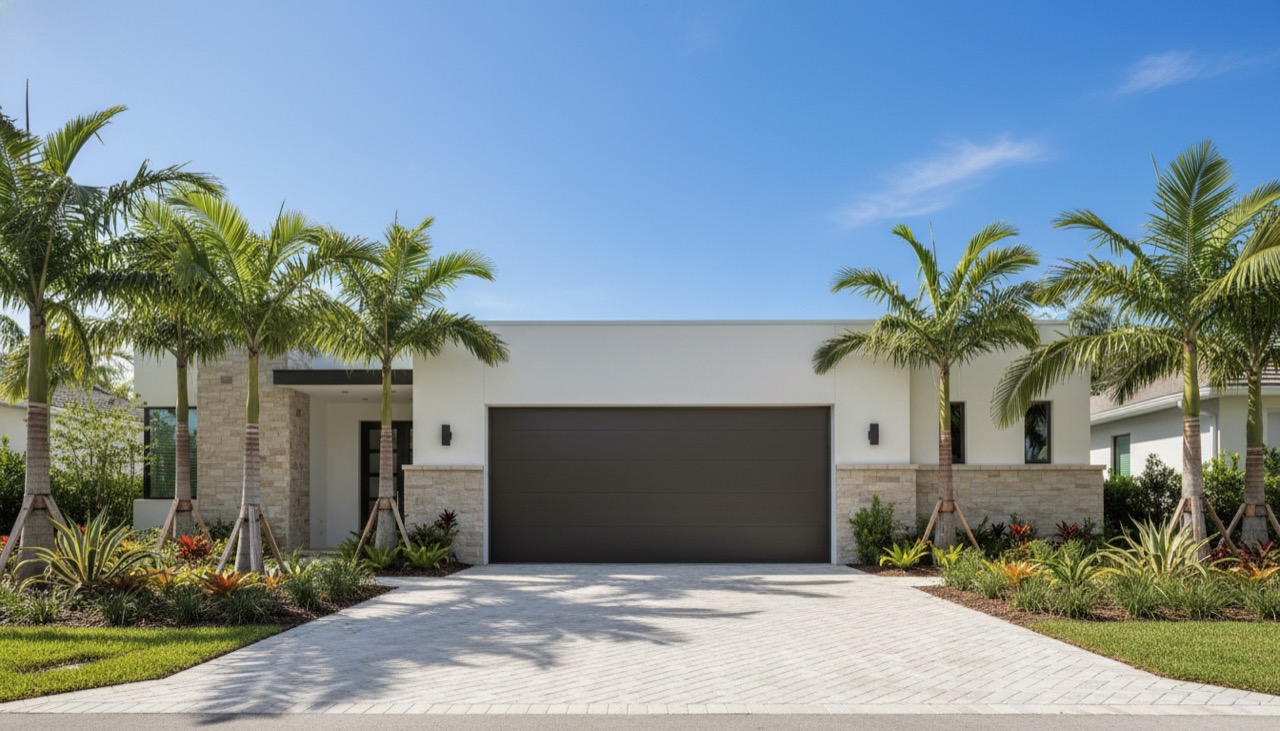
The garage door is the biggest weak point in a hurricane. It's the largest opening in the home, so if it buckles or is breached by debris, wind pressurizes the house from inside and can lift the roof. A door engineered to your wind zone — and built to resist large-missile impact — is one of the highest-value storm upgrades on the Gulf Coast, and it can lower your insurance. Getting ready for a specific storm? Start with the hurricane prep checklist.
Why the garage door fails first
Most homes have more square footage of garage door than any window or entry door. Under hurricane-force wind that broad, flat surface takes enormous load. If it bows inward and lets go — or a flying branch punches through — the sudden inrush of air pressurizes the structure. That internal pressure pushes up on the roof and out on the walls at the same time the storm pushes from outside. It's a primary path to catastrophic loss, and it's exactly why building codes single out the garage door.
Florida Building Code & wind zones
Most of Southwest Florida sits in a wind-borne debris region under the Florida Building Code, where exterior openings must resist both a calculated design pressure (DP), the wind load for your location, and large-missile impact. The required rating isn't one-size-fits-all: it depends on your address, exposure, and how close you are to open water. We calculate the design pressure for your home and spec a door that meets or exceeds it. Size is part of that math too: the wider the door, the more wind load its panels carry, so a double-car door needs the stronger spec. Typical dimensions are in our standard garage door sizes guide.
What "impact-rated" actually means
- Wind-load rated — the door assembly is tested to a positive and negative design pressure (it won't blow in or suck out)
- Impact rated — it resists large-missile debris without being breached
- Code-stamped — it carries a Florida Product Approval or Miami-Dade NOA for documentation
- Reinforced — heavier-gauge sections, struts, and hardware, not a builder-grade shell
You'll see these doors sold as hurricane-rated garage doors, wind-rated garage doors, or even "hurricane-proof." The honest word is rated: no door is hurricane-proof, but a door tested to your design pressure and the large-missile standard is engineered for the worst day your address is likely to see — and that rating is what your permit and your insurer actually recognize.
The insurance payoff
Florida rewards storm hardening. A code-compliant, wind-rated garage door can qualify for a wind-mitigation credit on your homeowner's policy — meaning the upgrade can pay you back year after year. After we install, you get the wind-mitigation documentation to hand to your insurer or inspector.
Grants: My Safe Florida Home
Florida will help pay for this upgrade. The state's My Safe Florida Home program offers free wind-mitigation inspections and matching grants — historically up to $10,000 — and opening protection like a code-rated garage door is one of the improvements it covers. Our guide breaks down eligibility, how the dollar match works, and the steps from inspection to reimbursement.
Salt air: the slow storm
Hurricanes are the dramatic threat; salt air is the constant one. Coastal humidity corrodes springs, cables, rollers, and hardware — the very components a door depends on to operate and to hold up under load. We install galvanized, coastal-grade parts as standard, because a storm-rated door is only as reliable as the hardware moving it.
Reinforce or replace?
If your door is newer, some models accept a bracing kit or retrofit, but bracing must be installed before the storm and is not a substitute for a code-rated door. If your door is older, already corroded, or not rated for your zone, replacement is the safer and often more cost-effective path. We inspect honestly and give you both options in writing. Either way, learn your door's manual release before the season: our guide to opening the door by hand when the power is out covers it in five minutes.
Our storm-ready process
We calculate the design pressure for your address and inspect your current door and hardware.
We match a door rating to your zone and quote it in writing, with financing options.
We pull the permit and install to Florida Building Code with reinforced, coastal-grade hardware.
You get the paperwork for your insurer — so the upgrade can lower your premium.
Rated for the worst day
We spec to your design pressure.
A door that's right for inland Fort Myers isn't necessarily right for a barrier island in Marco. We match the rating to your exposure — documented for your insurer.
- Positive & negative design-pressure rated
- Large-missile impact resistant
- Florida Product Approval / Miami-Dade NOA
Related
Make it happen.
Storm-ready FAQ
Questions homeowners ask.
Why is the garage door the weak point in a hurricane?
It's the largest opening in the home. If it buckles or is breached by debris, wind pressurizes the house from inside, pushing up on the roof and out on the walls — a leading cause of catastrophic storm loss.
What does "impact-rated" mean?
The door is engineered and tested to a design pressure (wind load) and to resist large-missile debris, per the Florida Building Code. We spec the rating to your exact address.
Are "hurricane-proof" garage doors a real thing?
No door is hurricane-proof — treat that phrase as marketing. What exists is a hurricane-rated door: tested to a design pressure and large-missile impact standard under the Florida Building Code. We spec that rating to your address, which is what your permit, your insurer, and the storm actually care about.
Can a grant help pay for a storm-rated door?
Often, yes — Florida's My Safe Florida Home program has offered free wind-mitigation inspections and matching grants up to $10,000, and garage door opening protection is a covered improvement. See our grant guide for eligibility and steps.
Will it lower my insurance?
Often — a code-compliant wind-rated door can qualify for a wind-mitigation credit. We provide the documentation your insurer needs, including the wind-mitigation paperwork (Florida OIR-B1-1802 form) that goes into your inspection report.
Can my existing door be reinforced instead?
Sometimes, with a bracing kit installed before the storm — but bracing isn't a substitute for a code-rated door. We'll inspect and tell you honestly.
Does salt air really matter?
Yes — it corrodes springs, cables, rollers, and hardware faster than inland, weakening the parts a door relies on. We use galvanized, coastal-grade components.
When should I install before hurricane season?
Aim for late winter or early spring. Hurricane season runs June 1–November 30, and impact-rated doors take a couple of weeks from consultation to install once permitting is factored in. Demand spikes every June — booking early avoids the rush and the risk of a storm watch arriving before your door does.
Can I finance a storm-ready door?
Yes — one of the most popular projects to finance, since the wind-mitigation insurance credit can offset part of the monthly payment. Flexible monthly terms through our lending partners, subject to credit approval.
Get storm-ready before the season.
A wind-zone assessment, a door spec'd to your address, and the insurance paperwork to match — backed by 35 years on this coast.
(239) 541-0300